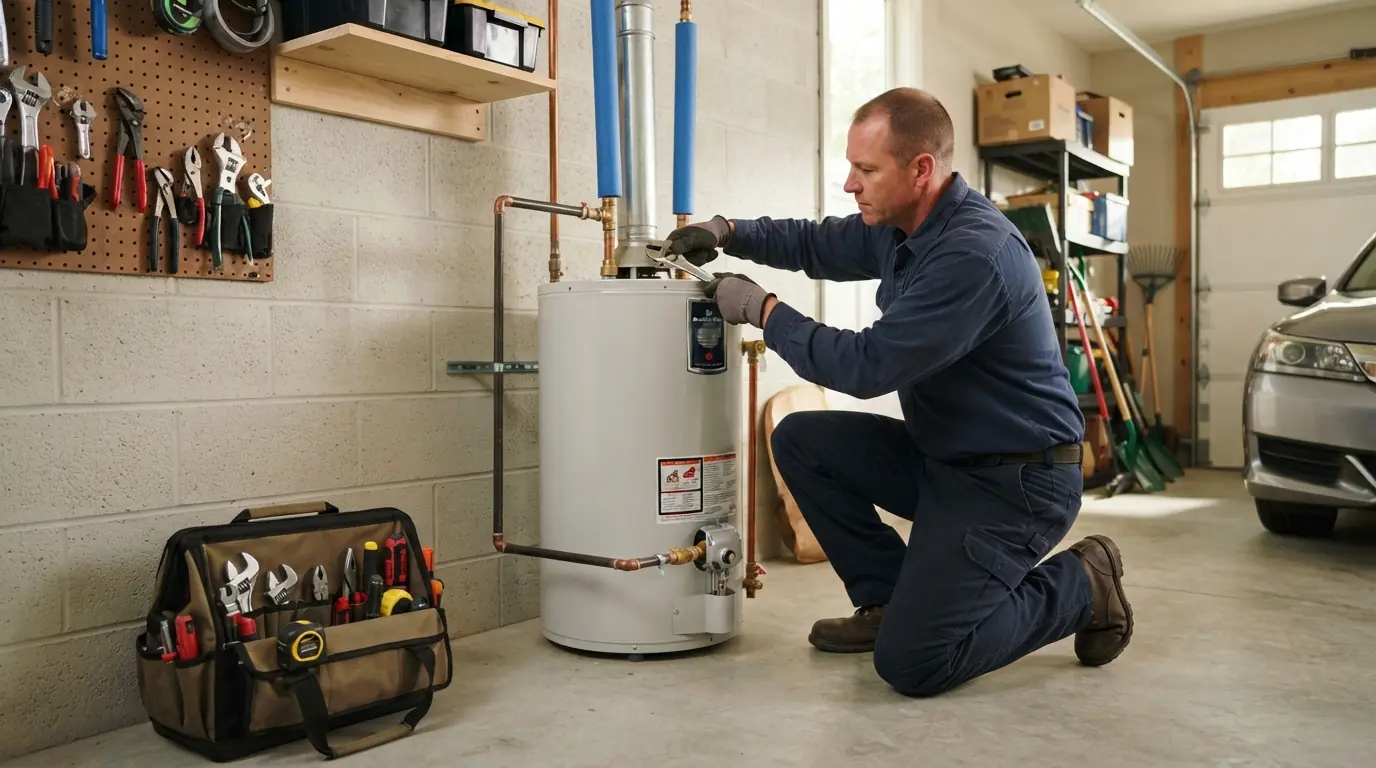
Water softener installation in Knoxville, TN starts with a hardness test, because KUB water measures about 60 to 120 ppm while private wells often run higher. The softener is sized in grains from that number and your household's use, then plumbed with a bypass valve, a drain line with an air gap, and a hard-water loop for outside spigots.
Updated October 2026
Do You Actually Need a Softener on Knoxville Water?
Honest answer: many homes on city water do not strictly need one. Moderately hard water spots glassware, films shower glass and slowly scales a water heater, but it rarely ruins plumbing. Where a softener clearly pays is a tankless heater, whose narrow heat exchanger scales far faster than a tank, and any home on a well.
That's why we test first. If the number is modest and you run a tank heater, a salt-free conditioner or nothing at all may be right, and we will say so. If you have a Navien or Rinnai tankless unit, or well water is leaving orange and white rings in the toilet, a properly sized softener is money well spent.
What Changes the Price of a Softener
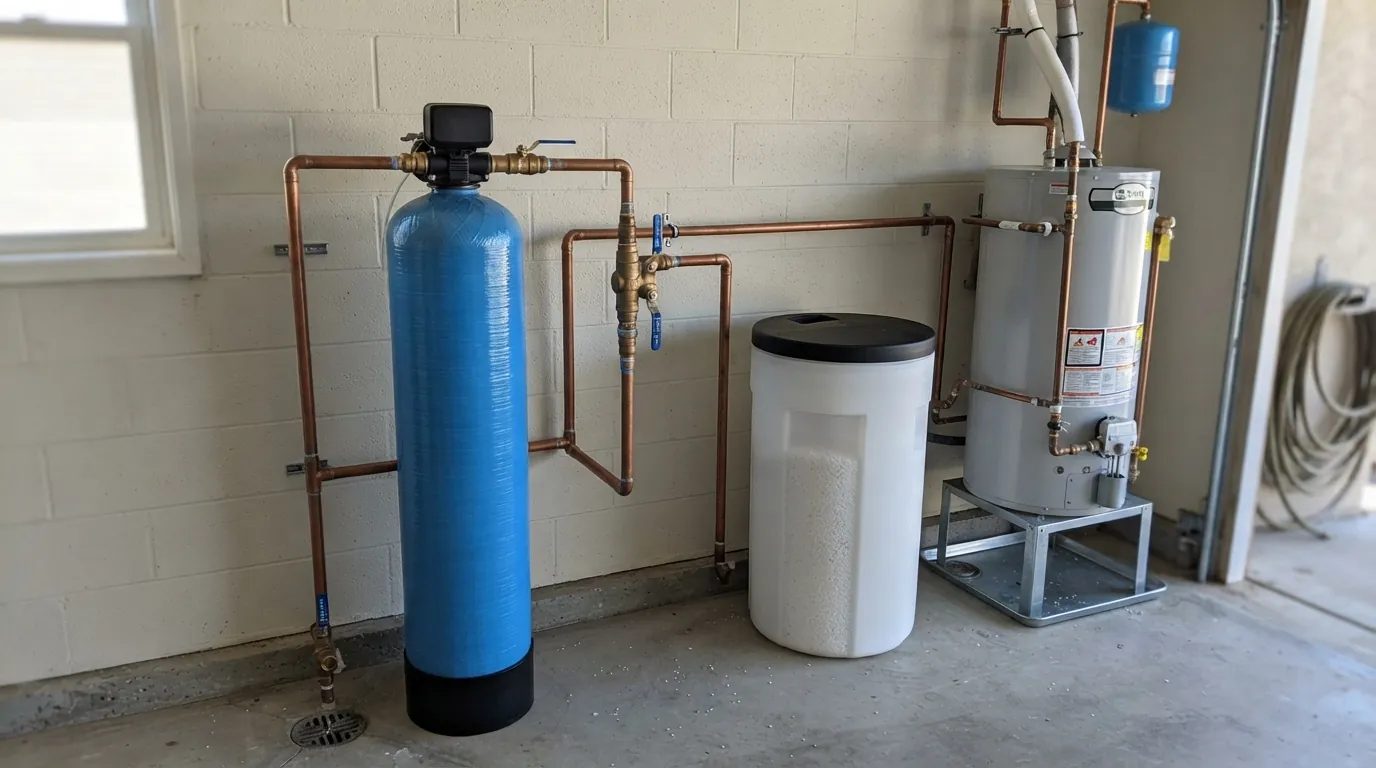
Equipment is most of the price; the install is what varies from house to house. These are the pieces that change the number.
A salt-free conditioner needs no drain or outlet and goes in quicker than an ion-exchange softener.
Larger resin tanks and metered valves cost more up front and less in salt later.
A garage or basement near the main is simplest; a crawlspace or a long run to reach the main adds labor.
No standpipe or outlet nearby means running one.
Iron or sediment in well water may call for a prefilter ahead of the softener.
Ion-Exchange Softener, Salt-Free Conditioner or Nothing
Three honest options, depending on your test result and your equipment.
| Option | What it does | Needs | Best fit |
|---|---|---|---|
| Ion-exchange softener | Removes calcium and magnesium | Salt, a drain, an outlet | Wells, hard water, scale everywhere |
| Salt-free conditioner | Keeps minerals from sticking; removes none | No salt, no drain | City water feeding a tankless heater |
| No treatment | Nothing | Nothing | Moderate city water, tank heater, no complaints |
Softener Sizing
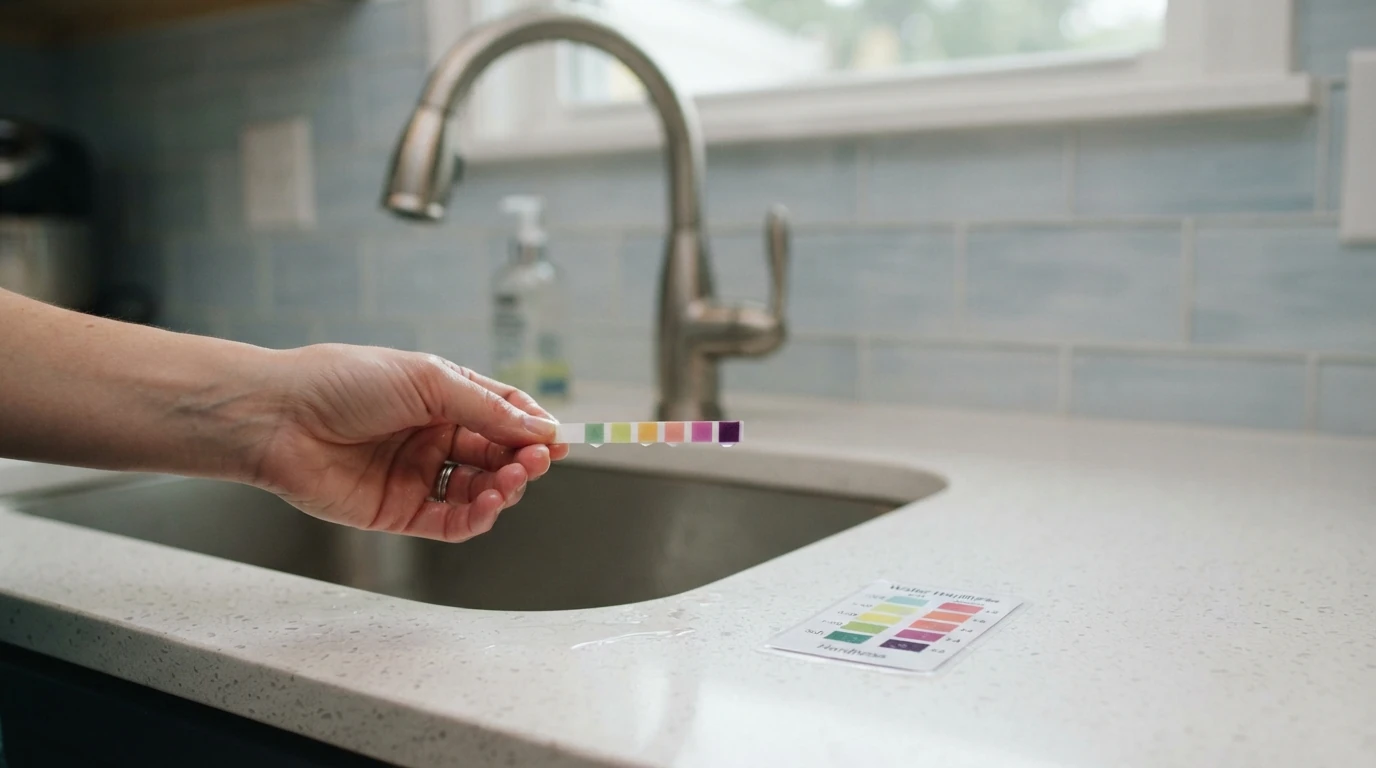
A softener is rated by how many grains of hardness it removes between regenerations. We take the tested hardness in grains per gallon, multiply by your household's daily use, and pick a resin volume that regenerates about once a week. Too small and it regenerates constantly, wasting salt and water; too large and the resin sits idle and can channel. If the test shows iron, we size up, because iron fouls resin faster than hardness does. The control valve matters as much as the tank: a metered valve such as a Fleck regenerates on actual use rather than on a timer.
Bypass Valve and Drain Line
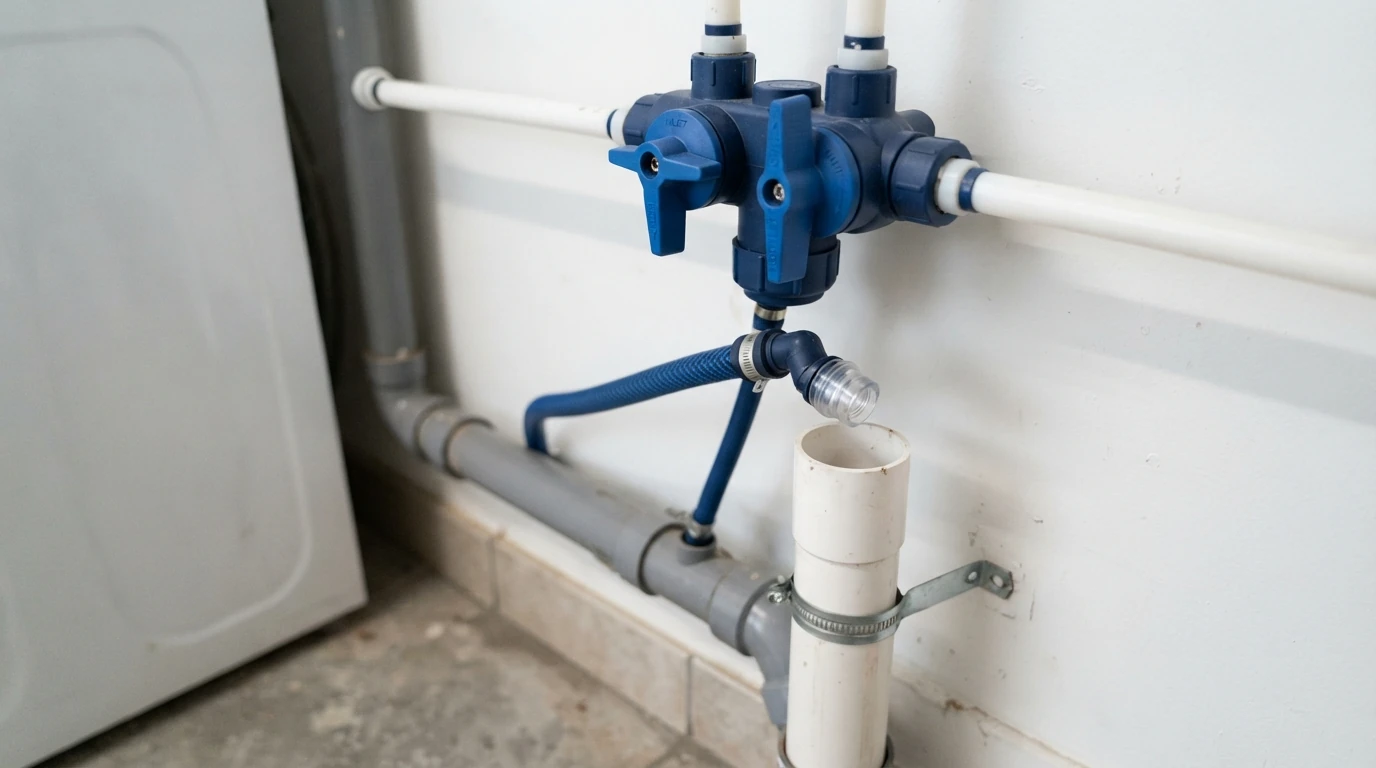
Every softener we install gets a bypass valve, so it can be taken offline for service without shutting off the house. The regeneration water needs a drain, usually a standpipe, laundry drain or floor drain, with an air gap so waste cannot siphon back into the resin. We also decide where it tees in: the kitchen cold tap and outside hose bibs are often left on hard water, which saves salt on water nobody needs softened. The spot has to leave room for salt bags and stay above freezing all winter.
Salt Softener vs Salt-Free Conditioner
An ion-exchange softener removes calcium and magnesium by trading them for sodium, which is why it needs salt and a drain. A salt-free conditioner, usually template-assisted crystallization, removes no hardness at all; it turns the minerals into crystals less likely to stick to surfaces. For moderately hard city water feeding a tankless heater, a conditioner is often enough. For a hard well or visible scale everywhere, only a true softener delivers soft water. Whole-house filtration is a separate question, aimed at chlorine taste and sediment.
City Water, Well Water and Where Hardness Bites
Installing a Softener, Start to Finish
- 1
Test the water
Hardness, iron and pH measured at the tap, well or city.
- 2
Size and site
Resin volume and valve chosen; location picked for drain, power, salt access and freeze protection.
- 3
Plumb it in
Main line cut, bypass fitted, hard-water loop to spigots if wanted, drain with an air gap.
- 4
Program and start up
Valve set to your hardness and household, resin backwashed, brine tank filled.
- 5
Retest
Hardness checked at a fixture after regeneration, and salt top-up explained.
Water Softener Installation Questions From Knoxville Homeowners
Does KUB water need a softener?
Not always. At roughly 5 grains per gallon it is moderately hard. Tankless heaters and homes with visible scale benefit; many others do fine without.
How often will I add salt?
It depends on hardness and household size. Programming the valve to your test keeps salt use as low as the water allows.
Will soft water hurt my water heater?
Softened water can wear the tank's anode rod faster, so have it checked during routine heater maintenance. It also stops the scale that would otherwise settle in the bottom of the tank.
Can a softener go outside or in a crawlspace?
Only where it can't freeze. Knoxville winters bring hard freezes, so we keep the resin tank and valve in conditioned or protected space whenever possible.
Do you service softeners you didn't install?
Yes. We rebuild valves, replace resin and clear bridged salt on the common brands.
Is softened water fine to drink?
Softening adds a small amount of sodium. Anyone limiting sodium can keep the kitchen cold tap on unsoftened water.
Other Water Quality & Maintenance Jobs We Handle
Septic to Sewer Conversion
Tap fee and permit and septic tank abandonment.
More on septic to sewer conversionWell Pump Repair & Replacement
No water from the well and waterlogged pressure tank.
More on well pump repair & replacementLow Water Pressure Repair
Pressure regulator replacement and clogged aerators vs supply problems.
More on low water pressure repairWater Pressure Booster Pump
Booster pump sizing and booster with pressure tank.
More on water pressure booster pumpWant to know what your water measures?
Call to book a test and an honest recommendation: softener, conditioner or neither.